
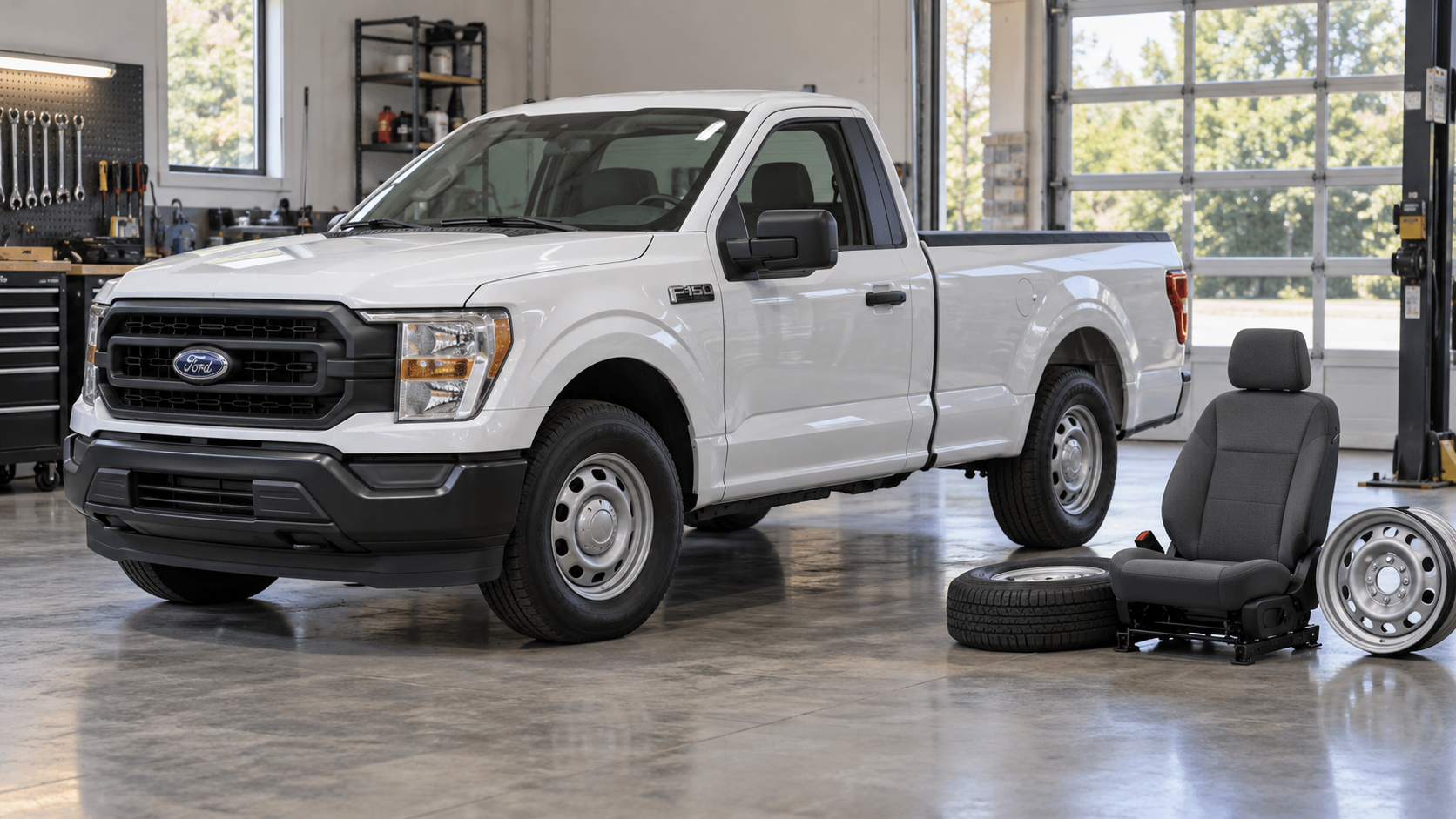
Full-size pickup trucks aren’t exactly known for being lightweight, but the 2021 Ford F-150 is an interesting exception. In its lightest configuration, it weighs barely more than 4,000 pounds, which makes it surprisingly light for a modern full-size truck.
Start removing unnecessary equipment and choosing lighter replacement parts, and it may be possible to get a basic F-150 well below its factory curb weight without radically changing the truck.
Here’s how light the 2021 F-150 starts, what fuel economy you can expect, and which weight-reduction modifications make the most sense.
What Is the Lightest 2021 Ford F-150?
The lightest 2021 Ford F-150 configuration is approximately:
- F-150 XL Regular Cab
- 4×2 rear-wheel drive
- 6.5-foot bed
- 3.3L Ti-VCT naturally aspirated V6
- 10-speed automatic transmission
- Base curb weight: 4,021 pounds
Ford’s 3.3-liter V6 produces 290 horsepower and 265 lb-ft of torque. It isn’t the fastest F-150 engine, but its simplicity and relatively low weight make it an interesting starting point for someone who wants the lightest possible modern F-150.
2021 F-150 3.3L V6 MPG
Ford lists the rear-wheel-drive 2021 F-150 with the 3.3L V6 at:
| Driving | EPA-Estimated MPG |
|---|---|
| City | 20 MPG |
| Highway | 24 MPG |
| Combined | 21 MPG |
Those numbers are respectable for a naturally aspirated full-size pickup, although Ford’s 2.7L EcoBoost actually carries a higher 22-MPG combined rating in 4×2 form.
Removing weight can theoretically improve fuel economy, particularly during stop-and-go driving where the engine repeatedly has to accelerate the truck’s mass. However, dropping 100 or 200 pounds isn’t going to suddenly turn an F-150 into a 30-MPG truck.
At highway speeds, aerodynamics become increasingly important, so reducing drag may matter more than removing another 50 pounds.
How Much Weight Can You Remove From an F-150?
A practical lightweight build could potentially remove around 100 to 250 pounds without completely stripping the truck.
A much more aggressive build could remove considerably more, but you’ll start sacrificing comfort, practicality, noise insulation, towing equipment, and everyday usability.
Starting from approximately 4,021 pounds, losing 200 pounds would put the truck at roughly 3,820 pounds.
That’s remarkably light for a modern full-size pickup.
1. Remove the Passenger Seat
If the truck is being built primarily as a one-person commuter, project truck, or track-oriented vehicle, the passenger seat is one of the most obvious removable components.
Depending on the specific seat and equipment, removing it could potentially save roughly 40 to 60 pounds.
There is an important complication, though. Modern seats can contain occupancy sensors, airbags, seatbelt sensors, wiring, and other components connected to the Supplemental Restraint System.
Simply unplugging and removing the seat may illuminate an airbag warning light or affect the restraint system. Don’t attempt to trick or bypass the airbag system with homemade resistors or other workarounds.
If the truck will ever carry a passenger again, keeping the factory seat and safety equipment intact is the much more practical choice.
2. Switch to Lightweight Wheels
Lightweight wheels may be one of the best modifications on this list because they reduce both overall vehicle mass and unsprung rotating mass.
If you can save 8 to 12 pounds per wheel, that’s roughly:
32 to 48 pounds removed from the truck.
Unlike pulling out carpet or interior trim, lighter wheels may also improve how responsive the truck feels when accelerating, braking, and changing direction.
Just make sure the replacement wheels have an adequate load rating for the truck. Don’t sacrifice wheel strength simply to chase a lower number on the scale.
3. Choose Lighter Tires
Tire weights can vary surprisingly widely between models.
A heavy all-terrain or LT-rated tire may weigh considerably more than a lighter highway-oriented tire of similar dimensions.
Depending on what is currently installed, changing tires could potentially remove another 10 to 30 pounds total.
For a street truck focused on fuel economy, a lighter low-rolling-resistance highway tire may make considerably more sense than an aggressive all-terrain tire.
4. Remove the Spare Tire
The spare tire and wheel mounted underneath the bed represent another large removable chunk of weight.
Depending on wheel and tire size, removing the spare and related hardware could eliminate roughly 50 to 70 pounds.
There’s an obvious downside: you no longer have a spare tire.
For a dedicated local-use or performance build, that might be acceptable. For road trips, remote driving, or a daily work truck, the weight savings probably aren’t worth the inconvenience of getting stranded with a damaged tire.
5. Remove Unnecessary Hitch Equipment
If you never tow, inspect what’s hanging underneath the rear of the truck.
A receiver hitch and related hardware can add a meaningful amount of weight. Depending on the equipment, removing unused towing hardware could potentially eliminate 20 to 50 pounds.
Obviously, don’t remove anything you need for towing, structural integrity, or factory safety systems.
6. Install a Lighter Exhaust
The factory exhaust system is built for durability, noise control, emissions compliance, and mass production rather than minimum weight.
A carefully selected lighter exhaust system may remove around 10 to 30 pounds, depending on how much of the factory system is replaced.
The difference won’t be enormous, but it can contribute to a larger weight-reduction program.
Any exhaust changes should retain required emissions equipment and comply with local noise and emissions regulations.
7. Consider a Lightweight Battery
The factory 12-volt battery is another relatively heavy component.
Certain properly engineered lightweight automotive batteries can cut approximately 20 to 35 pounds compared with a conventional lead-acid battery.
This isn’t as simple as installing the smallest battery you can find. The replacement needs sufficient cold-cranking capability, charging-system compatibility, temperature tolerance, and capacity for the truck’s electrical demands.
8. Remove Running Boards and Accessories
Accessories add up quickly.
Potential weight sources include:
- Running boards or side steps
- Bed toolboxes
- Bed covers
- Brush guards
- Aftermarket bumpers
- Skid plates
- Bed organizers
- Unused towing accessories
A lightly equipped XL is preferable if low weight is the goal because you’re avoiding much of this equipment from the beginning.
9. Should You Remove the Tailgate?
The tailgate looks like an easy place to lose a large amount of weight, but it comes with a catch.
Removing it reduces vehicle weight, but that doesn’t necessarily mean better highway fuel economy.
Pickup beds develop a recirculating pocket of air behind the cab. Keeping the tailgate installed can actually help manage airflow over the bed. Removing or lowering the tailgate doesn’t automatically reduce aerodynamic drag.
For that reason, we’d leave the tailgate installed on an MPG-focused street build unless there’s another reason to remove it.
10. Stripping the Interior
If you’re willing to make the truck significantly less comfortable, there’s additional weight hiding inside the cab.
Possible targets include:
- Carpet
- Sound-deadening material
- Interior trim
- Speakers
- Console components
- Unused storage pieces
However, we’d put this close to the bottom of the list for a street-driven F-150.
Removing sound insulation often makes a vehicle dramatically louder while saving relatively little weight. Road, tire, drivetrain, exhaust, and wind noise all become more noticeable.
Saving 30 pounds isn’t particularly impressive if you make the truck miserable to drive every day.
A Sensible Lightweight F-150 Build
If we wanted to make the lightest practical 2021 F-150 while keeping it usable on the street, we’d start with the Regular Cab 4×2 3.3L V6 and focus on reversible modifications.
| Modification | Approximate Potential Weight Savings |
|---|---|
| Passenger seat | 40-60 lb |
| Lightweight wheels | 30-50 lb |
| Lighter tires | 10-30 lb |
| Spare tire | 50-70 lb |
| Unused hitch hardware | 20-50 lb |
| Lightweight battery | 20-35 lb |
| Lighter exhaust | 10-30 lb |
These are estimates rather than guaranteed figures. Actual component weights vary significantly depending on the truck’s original equipment and the replacement parts used.
Could You Get a 2021 F-150 Under 3,800 Pounds?
Potentially.
Starting at a base curb weight of approximately 4,021 pounds, removing 221 pounds would put the truck at 3,800 pounds.
A combination of a passenger-seat delete, lighter wheels and tires, spare-tire removal, lighter battery, lighter exhaust, and removal of unnecessary accessories could put a very basic truck somewhere around that territory.
Getting significantly lower would require increasingly aggressive modifications that probably don’t make sense for a normal daily driver.
Will Removing Weight Improve F-150 MPG?
It can, but keep your expectations realistic.
Weight reduction has its greatest effect when accelerating, climbing grades, and driving in stop-and-go conditions. At a steady 70 mph on the freeway, the engine is primarily fighting aerodynamic drag and rolling resistance.
If fuel economy is the primary goal, we’d combine modest weight reduction with:
- Highway-oriented low-rolling-resistance tires
- Proper tire pressures
- Lightweight wheels
- Minimal unnecessary cargo
- No large lift kit
- No oversized off-road tires
- No unnecessary exterior accessories that increase drag
- Moderate highway speeds
Those changes are more likely to produce a useful street truck than completely gutting the interior.
Bottom Line
The 2021 F-150 Regular Cab 4×2 with the 3.3L V6 is an unusually light starting point for a modern full-size pickup. At approximately 4,021 pounds, it weighs hundreds of pounds less than many crew-cab trucks before you’ve changed anything.
Ford rates the 3.3L 4×2 at 20 MPG city, 24 MPG highway, and 21 MPG combined.
If your goal is weight reduction, we’d start with lighter wheels and tires, unnecessary accessories, unused towing equipment, and potentially the spare tire before stripping apart the cab. Removing the passenger seat can save additional weight, but modern airbag and occupancy-sensing systems make that modification considerably more complicated than simply unbolting a seat.
A practical lightweight build could plausibly bring the truck toward the 3,800-pound range while retaining most of what makes an F-150 useful in the first place.
“`
Leave a Reply