
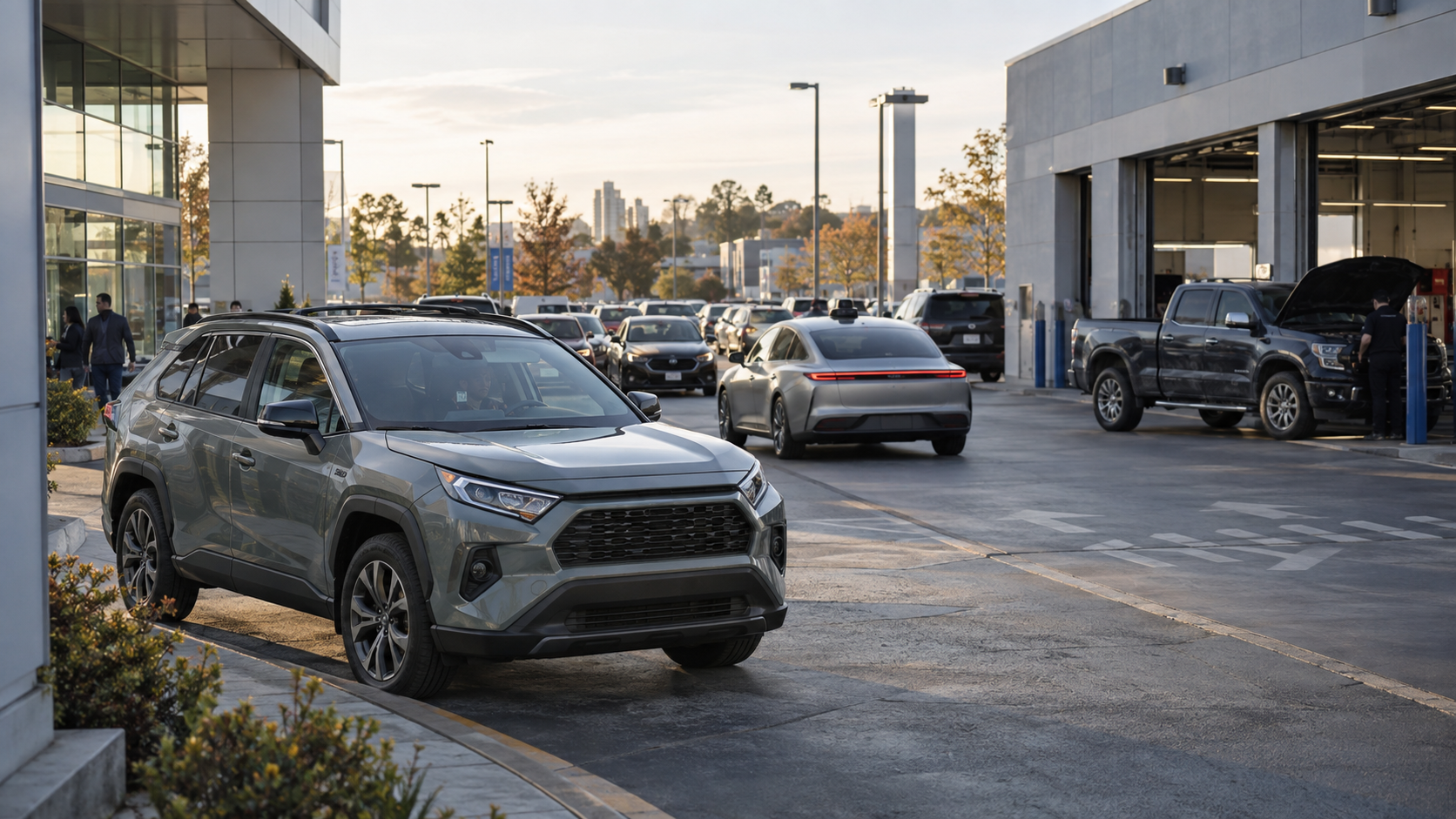
This week in the auto industry, hybrids continued gaining ground with U.S. buyers, Volkswagen signaled that it may develop more American-focused trucks and SUVs, Tesla put its steering-wheel-free Cybercab into limited service, and several major recalls affected Jeep, Ram and Chrysler vehicles.
Car buyers are also facing a less obvious ownership-cost problem: modern driver-assistance technology is making even relatively minor accident repairs more complicated and expensive.
Here are the automotive stories that matter most to car owners and shoppers this week.
U.S. Car Sales Strengthened in August, but EV Share Fell
U.S. light-vehicle sales ran at an annualized pace of about 16.8 million vehicles in August, up from July and stronger than many analysts expected. It marked another month in which overall vehicle demand remained relatively resilient despite high prices and borrowing costs.
The more interesting change was what consumers were buying. Battery-electric vehicles accounted for a smaller share of sales than they did a year earlier, while conventional hybrids continued gaining ground.
Toyota, for example, sold more than 124,000 electrified vehicles during August, with hybrids accounting for much of that volume.
Why Hybrids Continue to Gain Ground
The market is increasingly showing that electrification does not necessarily mean moving directly from gasoline vehicles to fully electric cars.
Hybrids offer many buyers a middle ground. They can substantially improve fuel economy without requiring home charging, long charging stops or major changes to driving habits.
That combination is especially appealing to shoppers buying mainstream SUVs and crossovers.
Expect automakers to continue adding hybrid versions of popular models over the next several years as they respond to consumer demand.
Volkswagen Is Considering Pickups and Tougher SUVs for America
Volkswagen is exploring new body-on-frame SUVs and pickup trucks designed specifically for the North American market as the German automaker looks for ways to increase its relatively small share of U.S. vehicle sales.
The company is also planning to expand its U.S. hybrid lineup and increasingly tailor its products to individual regions rather than relying on one global product strategy.
The pickup possibility is particularly interesting because Volkswagen has never established itself as a serious competitor in the enormous U.S. truck market.
A Volkswagen pickup or rugged SUV could eventually give shoppers another alternative to vehicles such as the Toyota Tacoma, Ford Ranger, Chevrolet Colorado and Ford Bronco.
What This Means for Buyers
Volkswagen has not yet announced a specific new pickup for sale, so there is no reason for buyers to delay a purchase based on these plans alone.
However, it is another indication that automakers are paying more attention to distinctly American preferences for trucks, rugged SUVs and hybrids.
Tesla Puts the Steering-Wheel-Free Cybercab Into Service
Tesla began offering limited public rides in its Cybercab in Austin, Texas. Unlike the Model Y vehicles Tesla has also used for robotaxi testing, the two-seat Cybercab is designed without a steering wheel or pedals.
The deployment represents an important step toward Tesla’s long-promised goal of operating vehicles designed entirely around autonomous driving rather than human control.
Federal regulators are watching closely. U.S. vehicle safety regulations generally assume that passenger cars have traditional controls, and vehicles built without them can face additional regulatory restrictions.
What This Means for Consumers
The Cybercab should still be viewed as an experimental and limited-use vehicle rather than something consumers will soon be able to buy at an ordinary Tesla store.
Regulatory approval, autonomous-driving performance and the ability to operate safely across a wide range of environments remain major hurdles before vehicles without steering wheels become common.
Still, the Austin deployment moves the Cybercab from the concept stage closer to real-world operation.
Modern Safety Technology Is Making Cars More Expensive to Repair
Advanced driver-assistance systems are making even relatively minor vehicle repairs more complicated.
Cameras, radar sensors and related electronics are increasingly built into bumpers, windshields, mirrors, grilles and other areas that are commonly damaged during collisions.
A bumper that once primarily consisted of plastic bodywork may now contain parking sensors, radar equipment, cameras and wiring. Replacing a windshield can also require recalibrating cameras used for automatic emergency braking, adaptive cruise control or lane-keeping systems.
That means a seemingly simple repair can require specialized parts, diagnostic equipment and additional labor.
What This Means for Owners
Purchase price and fuel economy no longer tell the whole story when comparing vehicles.
The cost of headlights, mirrors, bumpers, windshields and electronic sensors can make a significant difference in long-term ownership costs and insurance claims.
Buyers planning to keep a vehicle for many years may want to consider repair complexity alongside reliability, depreciation and fuel economy.
Recalls: Jeep, Ram and Chrysler
Jeep Recalls More Than 328,000 Grand Cherokees Over Rear Coil Springs
Stellantis is recalling approximately 328,000 Jeep Grand Cherokee-family vehicles because rear coil springs may have been installed incorrectly and could detach from the vehicle while driving.
The affected group includes certain 2021 through 2023 Grand Cherokee L vehicles and certain 2022 through 2023 Grand Cherokee and Grand Cherokee 4xe models. A detached spring could create a road hazard and increase the risk of a crash.
More Than 239,000 Ram 1500s Recalled for Backup-Camera Problem
Stellantis is also recalling approximately 239,000 2025 and 2026 Ram 1500 pickups because a radio software problem can prevent the rearview-camera image from appearing when the truck is shifted into Reverse.
The problem can reduce rear visibility and cause affected trucks to fail to meet federal rear-visibility requirements. The fix is software based and can be completed by a dealer or, on compatible vehicles, delivered through an over-the-air update.
Chrysler Pacifica and Voyager Recalled Over Stability-Control Problem
A smaller Stellantis recall affects certain 2025 and 2026 Chrysler Pacifica and Voyager vehicles, including some Pacifica plug-in hybrids.
A cracked capacitor inside the brake-pedal-position sensor can potentially cause the electronic stability-control system to stop functioning properly. Dealers will inspect affected vehicles and replace the sensor when necessary.
Because recall eligibility depends on the individual vehicle rather than simply the model and year, owners should check their VIN through the National Highway Traffic Safety Administration’s recall database.
Check your vehicle for open recalls at NHTSA.gov.
Washington Moves Toward Tougher Restrictions on Chinese Connected Cars
Major automakers are supporting efforts in Washington to strengthen restrictions on Chinese-made connected vehicles and related automotive technology entering the United States.
The concerns largely center around national security and the enormous amount of information modern connected vehicles can transmit through cellular, Bluetooth, Wi-Fi and other communications systems.
Existing trade barriers already make it difficult for major Chinese automakers to enter the U.S. market, and additional restrictions could make that path even harder.
What This Means for Buyers
American consumers should not expect inexpensive Chinese vehicles from manufacturers such as BYD to suddenly appear at U.S. dealerships.
Chinese automakers are expanding rapidly in many other parts of the world, but trade policy and national-security concerns continue to create significant barriers in the United States.
Quick Hits From the Auto Industry
- Honda is targeting major cost reductions: Honda is looking for billions of dollars in savings over the next several years as it competes against lower-cost automakers and deals with expensive investments in electrification and software.
- Chinese vehicle exports continue growing: Chinese automakers are increasingly relying on international markets as competition inside China intensifies. The immediate effect on U.S. buyers is limited, but the trend is putting additional pressure on established global automakers.
- Subaru Forester sales remain strong: Forester sales climbed significantly compared with a year earlier, reinforcing the model’s position as one of Subaru’s most important vehicles in the U.S. market.
- Hybrids continue to emerge as the industry’s middle ground: More manufacturers are expanding hybrid lineups as buyers look for better fuel economy without committing to a fully electric vehicle.
The Bottom Line
The clearest trend in this week’s automotive news is that the industry’s transition away from traditional gasoline vehicles is becoming more complicated than many automakers originally expected.
Fully electric vehicles remain an important part of manufacturers’ long-term strategies, but hybrids are increasingly becoming the practical choice for mainstream buyers. At the same time, companies are investing heavily in autonomous driving, software-defined vehicles and increasingly sophisticated safety technology.
Those advancements can make cars safer and more capable, but they can also increase repair costs and create new types of recalls that have more to do with software and electronics than traditional mechanical failures.
For shoppers, the result is an automotive market offering more technology and more powertrain choices than ever before, but also one where understanding long-term ownership costs is becoming increasingly important.
Sources include the National Highway Traffic Safety Administration, Reuters, automaker announcements and automotive industry sales data. Recall eligibility is vehicle-specific, and owners should verify any open recalls using their vehicle identification number.
“`
Leave a Reply