
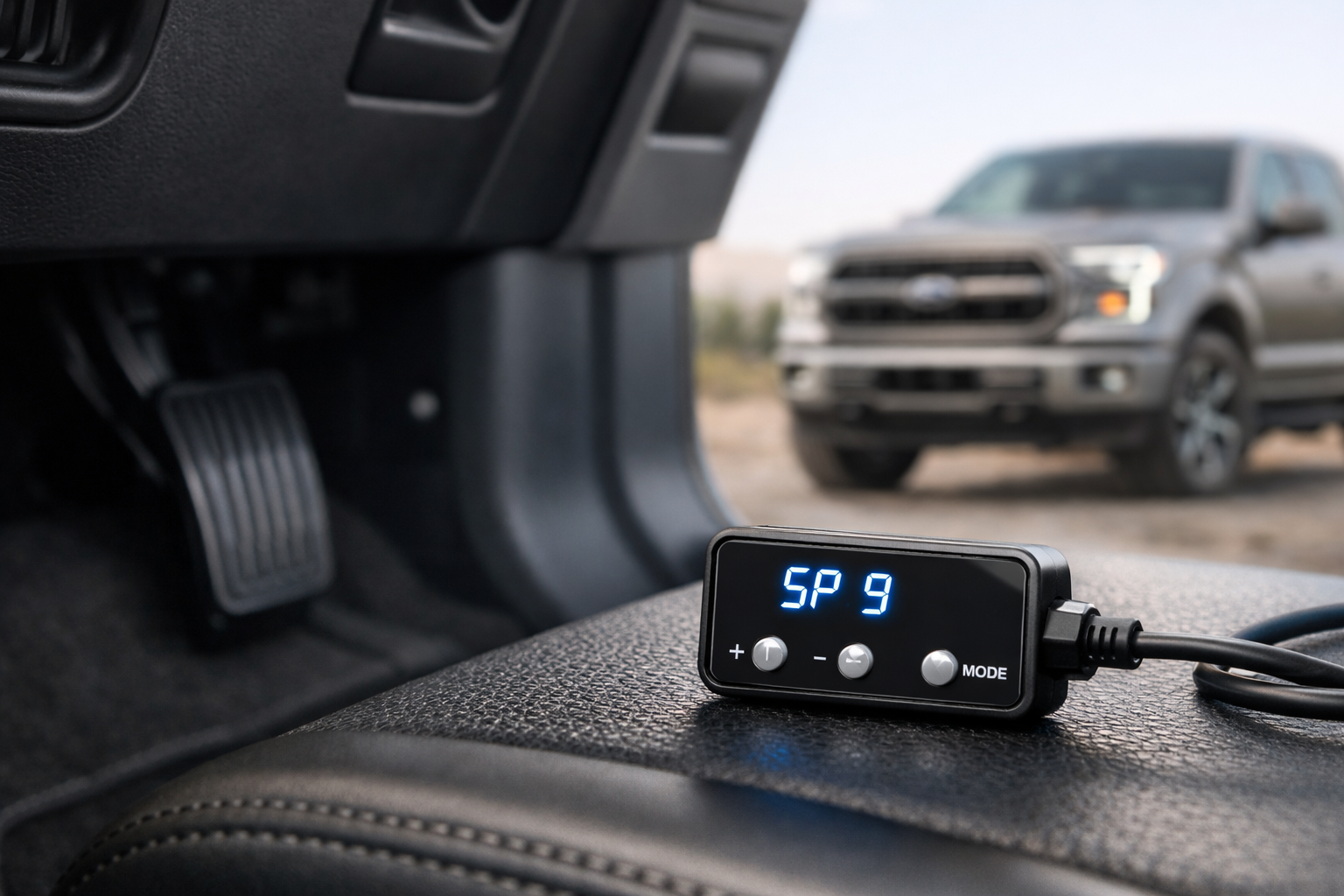
The Ford F-150 is America’s best-selling truck, and one of the most common complaints across both EcoBoost and V8 models is a frustrating delay between pressing the gas pedal and the truck actually responding. Ford’s drive-by-wire system intentionally softens throttle inputs to protect the drivetrain and improve fuel economy, but it makes the truck feel sluggish in situations where quick response matters most.
On EcoBoost models, the electronic throttle delay stacks with turbo spool time, creating a one-two punch of lag especially noticeable when towing or merging. A throttle response controller addresses the electronic half of this equation and makes a dramatic difference in how the F-150 drives.
How the F-150’s Throttle System Creates Lag
Both the 2.7L and 3.5L EcoBoost engines and the 5.0L Coyote V8 use drive-by-wire throttle with a progressive pedal map. Ford tunes the first 20% to 30% of pedal travel to be deliberately soft, which means you have to push the pedal further before the engine delivers proportional power.
This creates a dead zone at the beginning of pedal travel where your input produces minimal response. The EcoBoost engines compound this with turbo lag.
At low RPM, the turbos need a moment to build boost pressure before delivering their full torque. Combined with the electronic delay, the result is a noticeable pause between your input and the truck’s response, sometimes lasting a full second from a standstill. The turbo lag diminishes at higher RPM once the turbos are spooled, but the electronic delay is present across the entire RPM range.
The 5.0L Coyote V8 doesn’t have turbo lag to contend with, but the electronic mapping still dulls its naturally responsive character. Owners coming from older cable-throttle trucks notice the difference immediately. The Coyote wants to rev and respond, but the computer holds it back during initial pedal application.
Top Throttle Controllers for the F-150
Pedal Commander (Best Overall)
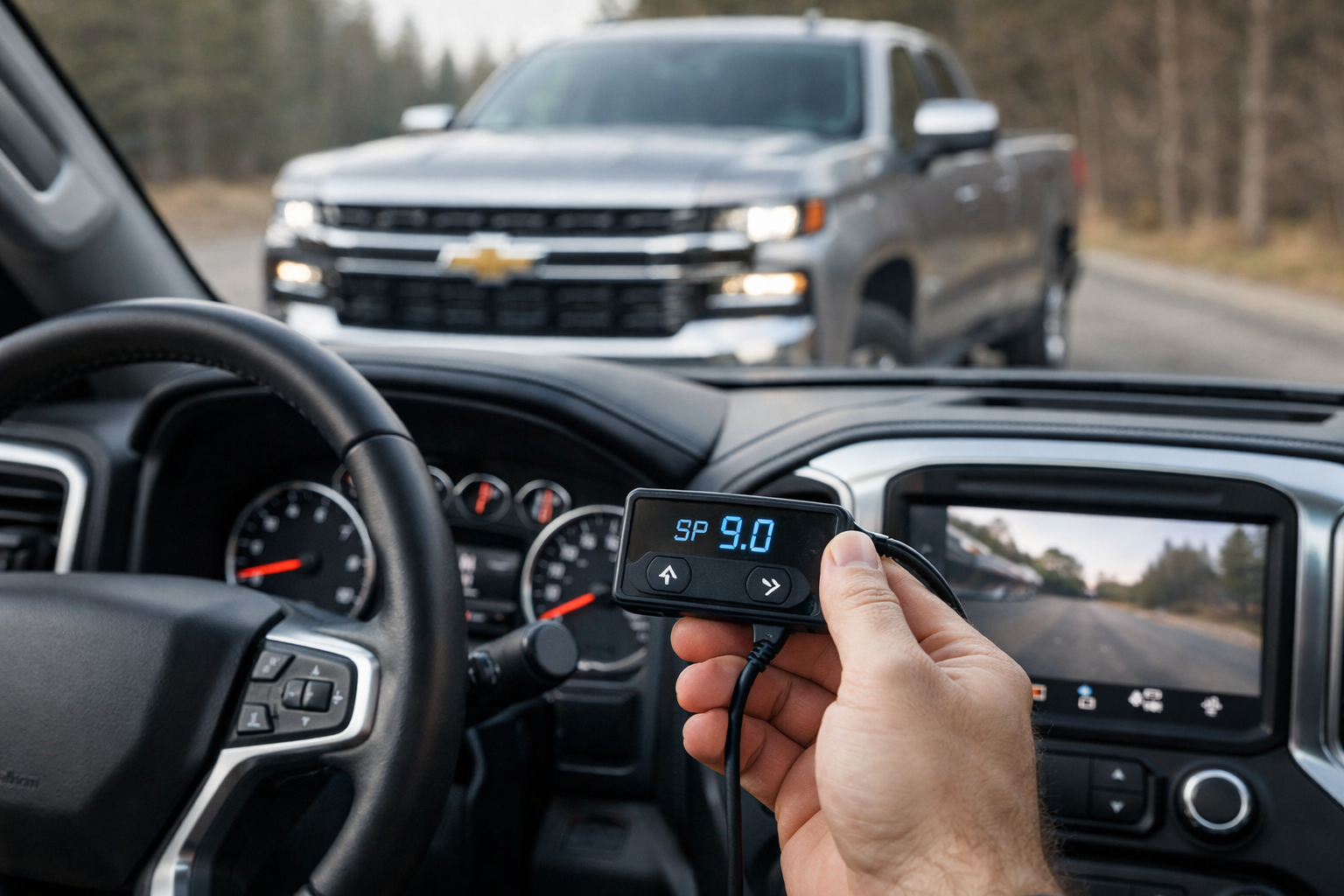
The Pedal Commander for Ford F-150 is the top seller for good reason. Four modes with 9 levels each give you precise control over sensitivity.
The Bluetooth app makes switching between towing, daily driving, and performance settings effortless, and the system remembers your last setting. It covers every F-150 generation from 2009 to present with model-specific harnesses, so verify your year when ordering.
For EcoBoost towing, City mode at level 5 to 7 provides crisper response without overwhelming the 10-speed transmission with sudden throttle demands. For the 5.0L V8, Sport mode at mid levels lets the Coyote’s natural responsiveness shine through by removing the electronic buffer Ford programmed into the pedal curve.
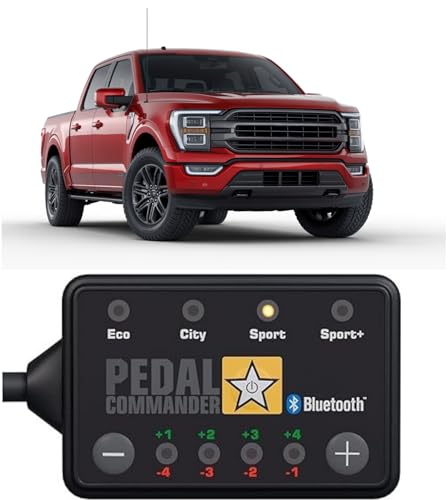
Pedal Commander for Ford F-150
The most popular F-150 throttle controller with Bluetooth app-based mode switching
ShiftPower Throttle Controller
The ShiftPower provides four modes with 12 levels each and an auto mode that adjusts based on driving behavior. Build quality is comparable to Pedal Commander, and it’s competitively priced.
The OLED display unit is compact and easy to read, and the auto mode works particularly well for F-150 owners who switch frequently between loaded and unloaded driving.

ShiftPower Throttle Controller
Auto-adjusting mode adapts to your driving style automatically
Budget Options
Generic controllers in the budget range work with the F-150’s pedal connector and deliver real throttle lag reduction. Expect fewer modes, a simpler interface (usually a knob or buttons instead of an app), and less refined build quality.
Brands like Carpuride and various Amazon-only offerings serve this market. The core benefit (faster pedal response) is present, and these make excellent test purchases for owners who want to try the concept before investing in a premium unit.
15-Minute Install Process
The F-150’s accelerator pedal connector sits at the top of the pedal assembly behind the gas pedal. Get on your back in the driver’s footwell and look up at the pedal bracket. You’ll see a 6-pin connector with a release tab.
Disconnect the factory harness, insert the controller’s Y-harness between the two connectors, and mount the control unit somewhere accessible. The 14th gen F-150 (2021+) has a slightly different connector location but the same basic installation process.
Always verify the correct harness for your specific model year when ordering, as the connector pin-out differs between generations. The entire job takes about 15 minutes, requires no tools, and makes no permanent modifications to the truck.
Does It Void Ford’s Warranty?
This is the most common concern for F-150 owners, and the answer is reassuring. A throttle controller doesn’t modify the ECU, doesn’t change engine tuning, and doesn’t alter any Ford software. It operates entirely on the pedal position signal, which is a passive sensor circuit.
Under the Magnuson-Moss Warranty Act, Ford would need to prove the controller directly caused whatever failure you’re claiming. Since it only changes pedal signal interpretation, establishing that causal link is essentially impossible.
In practice, unplugging the controller before a dealer visit takes 30 seconds and leaves zero evidence. There’s no software flag, no stored diagnostic code, and no physical trace of the installation. Many F-150 owners run controllers for the entire warranty period without ever removing them.
EcoBoost vs. V8: Which Benefits More?
EcoBoost owners generally notice a bigger improvement because they’re addressing the electronic lag that compounds with turbo spool time. The controller eliminates the electronic half of the delay, and the reduction in initial dead zone means the turbos begin spooling sooner in the acceleration event.
The result feels transformative, especially during low-speed maneuvers and initial acceleration from a stop. Many EcoBoost owners describe the improvement as making it feel like a completely different truck.
The 5.0L Coyote V8 feels immediately more responsive with even a moderate City mode setting. The naturally aspirated engine has no turbo lag to contend with, so removing the electronic delay lets the Coyote’s responsive, rev-happy character come through unfiltered. Parking lot maneuvers, highway merging, and passing all feel more direct and confidence-inspiring.
Best Settings for Common Driving Scenarios
For towing, stick with City mode at moderate levels (4 to 7). The goal is to eliminate the dead zone without triggering aggressive transmission behavior. The 10-speed automatic uses the throttle signal to determine shift timing, and a signal that jumps too quickly can cause unnecessary downshifts or gear hunting.
For daily commuting, City mode at level 5 to 7 or Sport mode at level 3 to 5 covers most situations. The truck responds to small pedal inputs proportionally, making traffic, parking lots, and highway merging feel natural and predictable.
For spirited unloaded driving, Sport mode at level 6 to 9 unleashes the full response. The truck feels eager and immediate, and the drivetrain delivers power the moment your foot moves. On the 5.0L V8, this setting lets you feel every bit of the Coyote’s 400 horsepower without the electronic filter softening the experience.
If you’re looking to maximize efficiency alongside performance, check out our guide on how to make your truck more fuel efficient for additional tips that pair well with throttle response tuning.
Frequently Asked Questions
Does a throttle controller help with towing the F-150?
Yes, significantly. The lag that’s mildly annoying during unloaded driving becomes genuinely concerning when you’re pulling a trailer and need to merge. A moderate City mode setting makes the truck respond predictably when loaded, giving you the confidence to merge and pass safely.
For more detailed towing comparisons, see our analysis of the Ford F-150 vs Chevy Silverado for towing a travel trailer.
Can I use it with Ford’s drive modes?
Yes. The controller works independently of Sport, Normal, Eco, Tow/Haul, and other selectable drive modes. You can stack the controller’s City mode with the truck’s Sport mode for maximum responsiveness, or pair it with Eco mode for a balanced experience.
Is a throttle controller the same as a tune?
No. An ECU tune modifies engine calibration tables, adjusting boost pressure, timing, and fuel delivery to produce more power. A throttle controller only changes how the pedal signal is interpreted.
It doesn’t add power, change engine parameters, or affect the PCM in any way. Many owners run both a tune and a controller together for the best combined result.
Will a throttle controller affect my fuel economy?
Not directly. The controller doesn’t change how much fuel the engine uses at any given throttle position. However, because the truck responds more quickly to smaller pedal inputs, many drivers find they use less pedal travel overall, which can actually improve fuel economy in daily driving.

Leave a Reply